

Meet The Member - Indu Khurana Counsellor
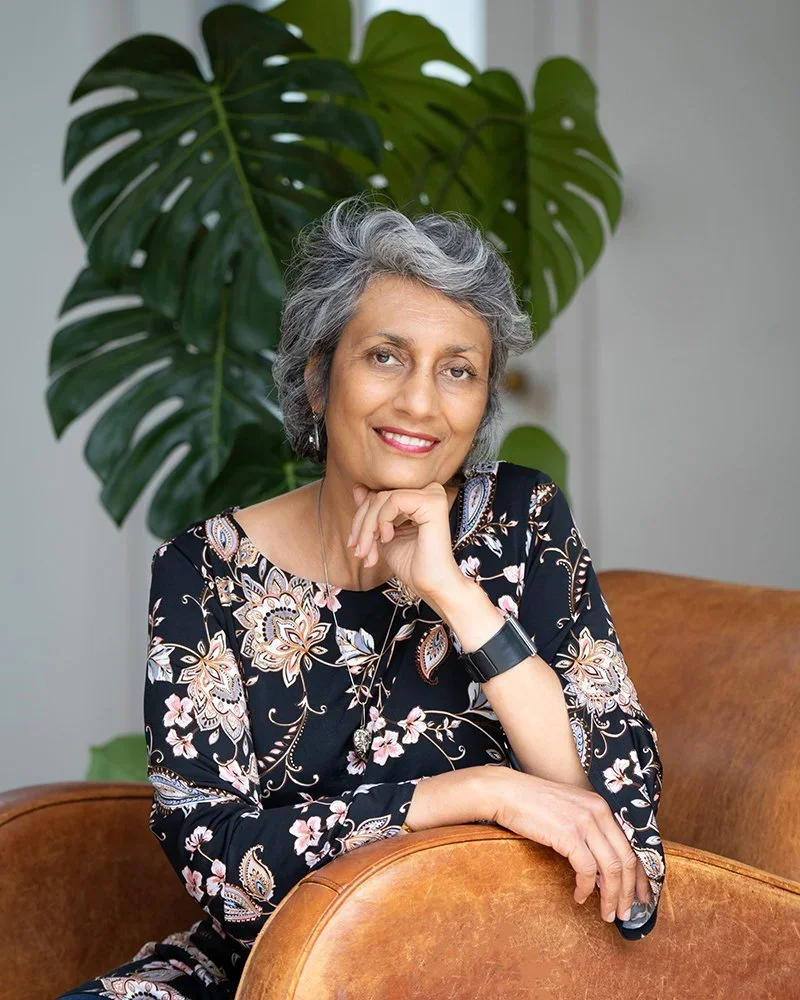
We caught up with Indu, a psychotherapist, MS Thrive Coach and Clinical Supervisor, to learn about her inspiring journey from a career in IT to running her own therapeutic practice in St Albans. Drawing on decades of experience across charities, the NHS and private practice, Indu now supports clients with stress, mental health challenges and long-term health conditions through a deeply personal, holistic approach rooted in emotional wellbeing, resilience and sustainable self-care.
We are very happy to have you as a member of We Are St Albans. We would love to hear about your journey. Have you always wanted to be a psychotherapist, MS Thrive coach and Clinical Supervisor? Did you do something different before?
Hi. I am delighted to be part of your gang! 😊 My journey is in no way straightforward.
Initially I had no idea what I wanted to do with my life. All I know was that the thought of the expected ‘professional’ jobs that were expected from my culture – accountant, doctor, lawyer etc did not excite me. So, my father suggested I train to be in Information Technology (I.T.). He thought this was a new and growing industry and would always keep me employed. I went for this undergrad training – in the days before the web existed. It was not the most inspiring, but it was ok. Perhaps the younger of your readers might express this as ‘meh’.
I worked as a computer programmer for about 12 years, utterly bored – for a number of reasons but always looking for an alternative career path.
Then I started voluntary work at Childline (Esther Rantzen days) and almost immediately, knew that I had found my niche in life. I loved the work as a telephone counsellor from day one.
I found some training – that turned out to be one of THE most rigorous, taking me 5 years just to achieve the Diploma. Then I worked for about 10 years consolidating my learnings. At the same time, I studied Coaching to Diploma level, gained a Diploma in Clinical Supervision and achieved my BACP Accreditation. Then I undertook a Masters (MA) in Child, Adolescent and Family Therapy.
Since then, I have been working for almost another 20 years. So, children and YP have always been a part of my working life (in Charities as well as in the NHS) in this career until the last 5 or 6.
All during this time, I have been researching health and wellbeing because I have been unwell since my 31st birthday and I wanted to keep myself well by natural and alternative means as the NHS had failed me (or so I felt).
So, when I started my business 4 years ago, it made sense to shift my focus from young people (YP) to long-term health conditions. This was primarily because I had kept getting burnt out (and therefore unwell) whilst working with YP in the NHS and I wanted to remain as well as possible. I also knew that I could truly help people with long-term health conditions – after all I had managed to keep myself well for nearly 2 decades, without medical intervention after the first time, and learnt a lot along the way.
Was it a big leap to start your own business? How have you found transitioning into having your practice?
It was a huge leap in some ways. But in other ways it felt very natural. I had felt hugely constrained by employment – it felt to my soul as though I was a slave to senseless procedures and heartless regimes, where the personhood of each employee was not seen (think 1984) in pursuit of targets. I felt as though I was not actually helping YP; more I was firefighting, keeping them from harming themselves and filling in lots of forms on a conveyor belt. I struggled with the targets that had been set by non-clinicians.
In my own business, I gave myself the flexibility to work at my pace, to have a level of control and to delegate work out that I did not want to do. I learnt on the job (as it were) to do my marketing, to do my bookkeeping. My clients are my motivation. Their results and willingness to put in the hard work that this work requires keeps me buoyant.
I started business after having a major operation to halt the progress of my own health condition, and I implement what I teach my clients. I walk the same talk as I give to my clients, daily.
What are some of the challenges that people are facing before coming to you?
People who come to see me have challenges ranging from unmanageable anxiety and low mood, relationship issues (partner, friendships, parental), work-related stress, bullying, friendship issues, feeling outsiders in life, to specific health concerns and not finding previous solutions to have been helpful, and anything in-between.
You talk a lot about stress management. What is the importance of stress management when dealing with health issues?
The importance of stress in health conditions is paramount. Stress has become our modern-day tiger. If it is not tamed, it can lead to significant deterioration in our systems. This is true whether you already have a health condition or not. Dealing with stress is not as straightforward as it can sound. For some it can just be a case of pounding it out of yourself by engaging in exercise, but I don’t believe this gets to the heart of the problem. This helps you to not think about your stressors in the short term. Until you understand what the source of your stress response is, you will always be pushing it down or pushing it away with strategies - until the next time.
When you have a health condition, if you can identify the source of your stressors, then you are going to kill it at source once and for all. I have the tools to help people to find those sources and then to address them there so that those same stressors do not affect you anymore. Stressors usually have an emotional source.
For someone who’s never practised visualisation, what are the benefits, and how can someone get into it?
The benefits of visualisations are varied. Visualisations help significantly with relaxing in your body and your mind. They enable you to regulate your breath, which regulates your nervous system. They enable you to use your mind’s eye to see a reality that is an aspired reality at one point in time but can become a real reality in another point in time. Visualisations hold a lot of power, and there is more and more evidence becoming available to ratify their power.
If you would like to get started with a visualisation, I have 3 powerful guided ones on my website. That means they have my voice, and I am guiding you every step of the way in each one. They are useful for different things btu the one that is universally useful is my Grounding visualisation is a great place to start. We all need to ground ourselves daily, sometimes more than once a day.
My protection visualisation is a great one for people who struggle with anxiety, stress and fear.
You can use these as many times as you want or need – you can access them for free, simply enter your name and email address to access them.
What is your favourite thing about running a business in St Albans?
My absolute favourite thing about running a business is being able to see the results my clients gain from working with me.
Is there anything that people feel particularly surprised by when it comes to psychotherapy?
No body has specifically said anything about this to me, but I envisage that one thing that may surprise people is that it if you cry in therapy, it does not mean that you will never stop crying.
Also, they may be surprised by the fact that it does actually work because it gets to the root cause of things.
If there is one thing you could implement in everyone’s lives related to your practice, what would it be?
Start journalling. Write down your thoughts and feelings. It is a great tool for spotting patterns.
When it comes to your business, what would you say you are most proud of?
I am most proud to be approaching the start of my 4th year in business and my health remaining stable. So, I am helping myself as well as helping others. The fact that my business, which is being run by a person with a health condition, is functioning as a business still, shows the need for my services.
Where in St. Albans is your favourite spot to go in your spare time?
I love going to Street Café in St Albans where the food is always good, the coffee is excellent and it’s a cool interior.
Tell us a fun fact about yourself.
I am loving connecting with my creative self after thinking I had to let it go. I used to love taking photographs with my SLR. Then when the SLR became too heavy for my MS-ridden body, I was gutted to think I could no longer pursue my one creative endeavour.
But with the advent of a great camera system in the Samsung phones (technically the best cameras), I find it still can. But because my legs and mobility can be restrictive still, I have connected with watercolour painting for the first time in my life and reconnected with my love of Am Dram.